YouTube announced on August 10, 2026 the first full YPP rewrite since 2018, effective February 1, 2027. New applicants will need 8,000 watch hours or 20 million Shorts views instead of the current 4,000 / 10 million. Anything you can push across the current threshold before February gets grandfathered under the old math — that's a five-month window and the single most time-sensitive item on this list.
OpenAI killed the Sora web and app experience back on April 26, 2026, and the API shuts off September 24, 2026. Any pipeline still calling Sora for motion breaks in under two weeks. The practical swaps are Kling 3.0, Seedance 2.0, or Veo 3.1, all of which now do synchronized dialogue and ambient audio in a single generation pass.
Kling AI hit the number one overall App Store slot in 42 countries — Germany, Portugal, Brazil, Thailand, the Philippines, Saudi Arabia, the UAE — on the back of the "Korean Baseball" effect. The format is one still image in, hyper-real KBO stadium broadcast footage out, with the subject "caught" on the jumbotron cam. Instagram Reels was the global breakout surface, with creators like @somdattaaa and @thisenola clearing six-figure likes; TikTok picked it up second and remixed it faster by stacking the AI clip against real KBO footage.
Shorts earn 15 to 30x less per thousand views than long-form, running roughly $0.05–$0.20 RPM out of a pooled 45% revenue share versus $3–$5 RPM at a 55% split on long-form. The spread by niche is brutal: finance and investing pull $9–$21 RPM, tech and AI news $5–$12, education $9–$14, true crime $8–$12, ambient and meditation $10–$11, while general entertainment sits at $2–$7. Copyrighted music on a Short shaves another ~33% off the top.
YouTube's inauthentic content policy, renamed from "repetitious content" on July 15, 2025, now runs channel-level detection instead of video-by-video. Enforcement is a three-strike ladder: warning, 90-day suspension, then permanent removal from the Partner Program. The line is replacement versus assistance — original script with AI polish is fine, templated mass-upload is the fastest route to demonetization.
Community benchmarks put the LTX-2 family at three to four times the generation speed of Wan 2.2 and HunyuanVideo, and it's the only open video family that runs on 12GB cards at all. LTX-2.3 is also the only open-source model doing native synchronized audio in a single diffusion pass, up to 4K at 50fps. HunyuanVideo 1.5 cut params from 13B to 8.3B, added sparse attention for a 1.87x speedup, and dropped to 14GB with offloading.
Kling 3.0 ships as three distinct sub-models rather than one general engine: 3.0 Omni for reference-image consistency on image-to-video, 3.0 Narrative for multi-shot sequences up to 15 seconds, and 3.0 Audio-Visual for character voice-driven animation. Reviewers consistently flag human motion — gait, gesture, lip-sync — as noticeably more natural than competitors. If your shot has a real-looking person moving or talking, this is the current ceiling.
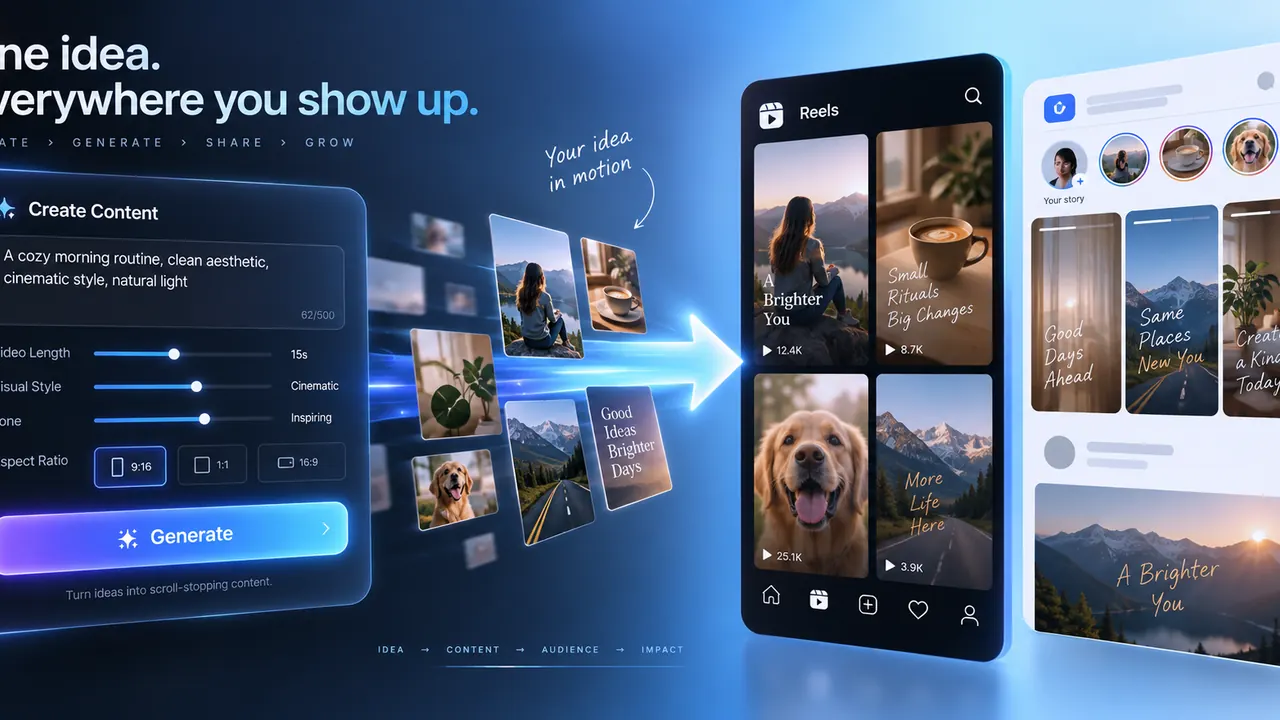
Vibes graduated out of the Meta AI app into standalone iOS and Android, and it cross-posts generated video straight into Instagram Reels and Facebook Stories from the creation interface. Meanwhile Instagram rolled out an opt-in "AI Creator" profile badge on May 4, 2026 — Meta states it does not affect algorithmic distribution. Caveat: Instagram has been down-ranking generic AI output since May 2026, so the label is free but the generic-ness is not.
Wan 2.2 remains the commercially safest open-weights base: Apache 2.0 licensed, weights on Hugging Face, running from 8GB VRAM on the 5B GGUF with memory offloading, with the 14B wanting 24GB+ for clean 480p and 720p. It caps at about five seconds per generation, but chaining last-frame back into I2V gets you 20 to 30 seconds of consistent motion. Wan 2.2 Fun Control adds ControlNet-style motion driving from Canny, depth, OpenPose, and MLSD.
AI content stays eligible for the Creativity Program as long as you flip TikTok's built-in "AI-generated content" label before posting; skipping it risks removal or program suspension. The 2026 policy explicitly targets unoriginal, low-quality, templated output for suppression. Hard stops remain on undisclosed synthetic media touching news, elections, health claims, or real public figures.