The January 2026 enforcement wave killed sixteen channels holding a combined 35 million subscribers, and the pattern it targets is templated uploads with near-zero variation — verbatim TTS over stock slideshows, mass-produced recycles. AI itself is explicitly fine: disclose synthetic elements and layer in genuine human value — commentary, research, original edit — and you stay monetizable. Faceless as a category is not banned, but 2026 enforcement is materially hotter than 2025.
MilX data across 274 channels and 13 niches puts Shorts RPM at just 3 to 14 percent of long-form RPM in nearly every vertical, with US Shorts landing near $0.33 per thousand views and the broad global range running $0.01 to $0.07. Translation: a 10-million-view Shorts month is roughly $3,300 US-weighted, not a salary. Shorts are a top-of-funnel acquisition channel — the money is downstream in long-form, affiliates, and products.
Noah Morris runs roughly 20 faceless channels at 2.5 million-plus combined subs, and one court-case video cost $250 to produce and returned over $20,000 on 5 million views. Fleet-wide, AI voice plus automated assembly has pushed per-video cost under $3, and operators who diversify report AdSense as only 30 to 50 percent of total income — a $10K/month ad channel typically grosses $25K to $40K with the full mix layered on.
Lightricks open-sourced LTX-2 with full weights, inference code, training code, and LoRA fine-tuning support under a permissive commercial license, generating synchronized audio-video up to 20 seconds at native 4K and 50fps with working lip sync. The March 2026 LTX-2.3 drop added a desktop editor that runs the whole model locally on consumer hardware. For an operator, this is zero marginal cost per generation and no API shutdown risk.
The Wan2.2-Stand-In workflow on Civitai locks a character's face identity while letting the model generate motion and scene freely, with with_neck and face_only_mode flags controlling how tightly the identity anchor holds. If you'd rather train, an I2V LoRA needs only 15 to 30 reference images across angles and trains in about 3.5 hours on 12GB VRAM at rank 32. That's recurring-character serialized content without a cloud bill.
TikTok's 2026 policy requires visible on-video labels for AI-generated visuals or audio depicting realistic people and scenes, and the platform auto-detects via C2PA Content Credentials even when you don't self-disclose. Labeled content still earns through Creator Rewards at normal thresholds, and TikTok states labeling does not automatically reduce distribution. Script writing and hashtag generation stay exempt — the trigger is synthetic people, voices, and realistic scenes.
ByteDance's Seedance 2.0 takes up to 12 mixed assets — text, images, video, audio — in a single generation and returns 1080p multi-shot output with synced native audio, consistent characters, and frame-level control over camera and lighting. ByteDance pushed it into consumer distribution through CapCut and Dreamina, which means your competition's floor just moved without them learning a node graph. Seedance 2.0 Fast currently sits third on the text-to-video arena board at 1747.
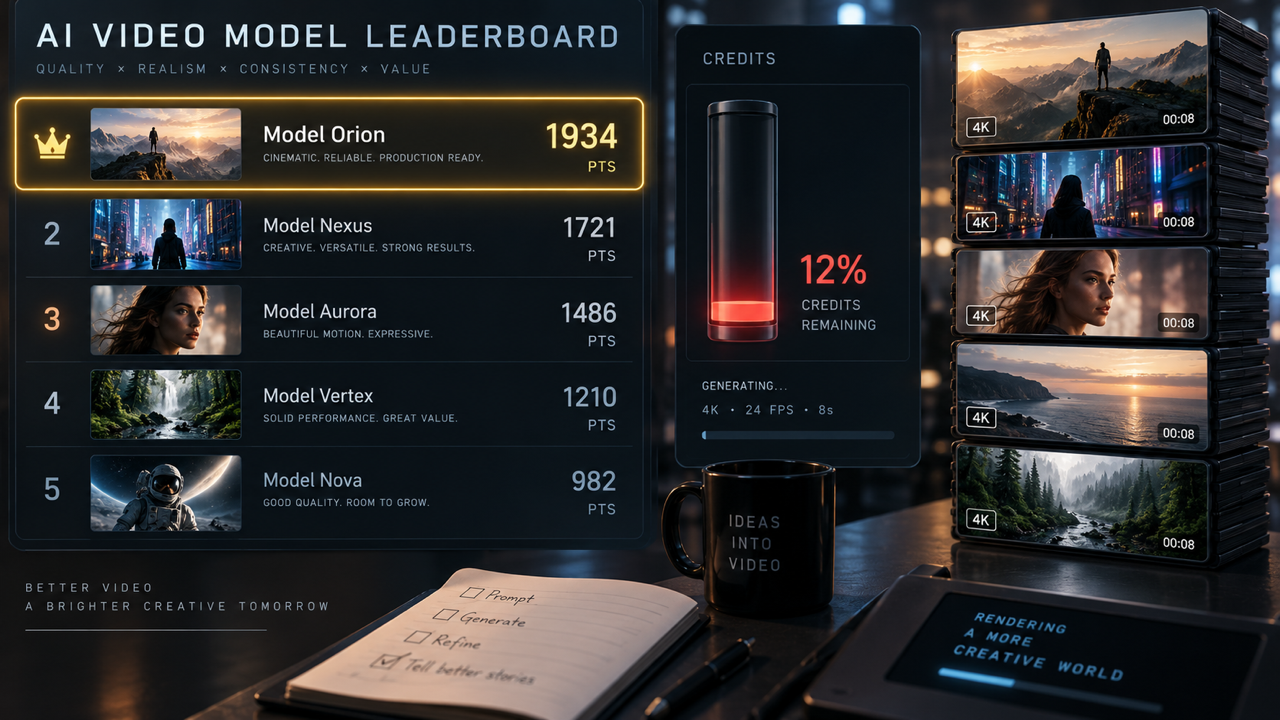
Kling v3 holds the top text-to-video arena score at 1934, shipping native 4K at 60fps, 15-second durations, lip-synced audio in five languages, and a Motion Brush for drawing motion paths directly on frames. The Pro tier runs $37/month for 3,000 credits, which realistically nets 15 to 20 usable 10-second Professional clips after iteration waste; API pricing is $0.56 to $0.70 per 5-second clip. Kling reports 60 million creators and 600 million videos generated.
The hyperreal AI ASMR cutting-and-eating format — glass, shoes, planets, crystals — has fused with brainrot pacing and is pulling creators up to $10,000 a month from ad revenue and sponsorships. The Italian brainrot subgenre is a distinct, separately-tooled variant with native Italian VO over gameplay backplates. The moat is thin and tooling is commoditized, so this is a speed play, not a build-for-years play.