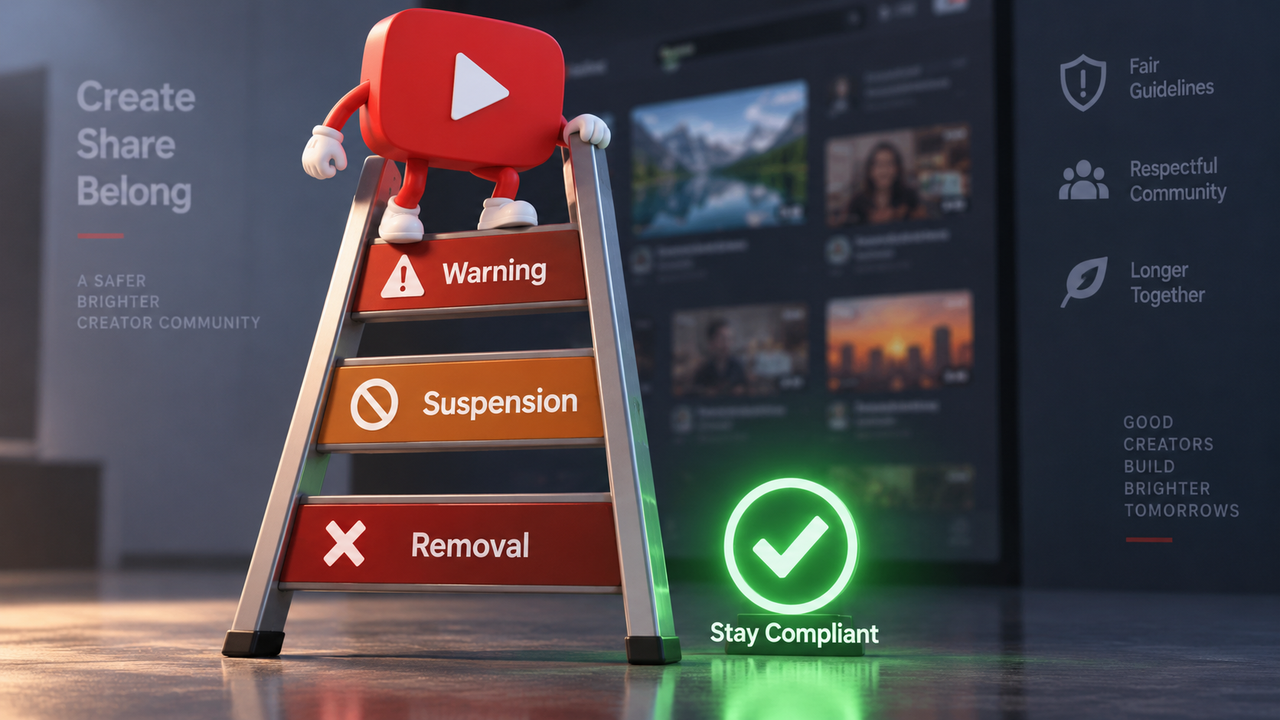
YouTube's clarified guidance splits non-monetizable work into three buckets: generic/template-based content, "off-putting or distressing" content, and AI personas giving health, finance, or legal advice. Enforcement is a three-strike ladder — warning, 90-day suspension, then permanent YPP removal — and it applies to Shorts identically. The escape hatch is explicit: original commentary, real research, and distinct storytelling stay fully monetizable, so the fix is a human-perspective layer on top of the pipeline, not fewer AI tools.
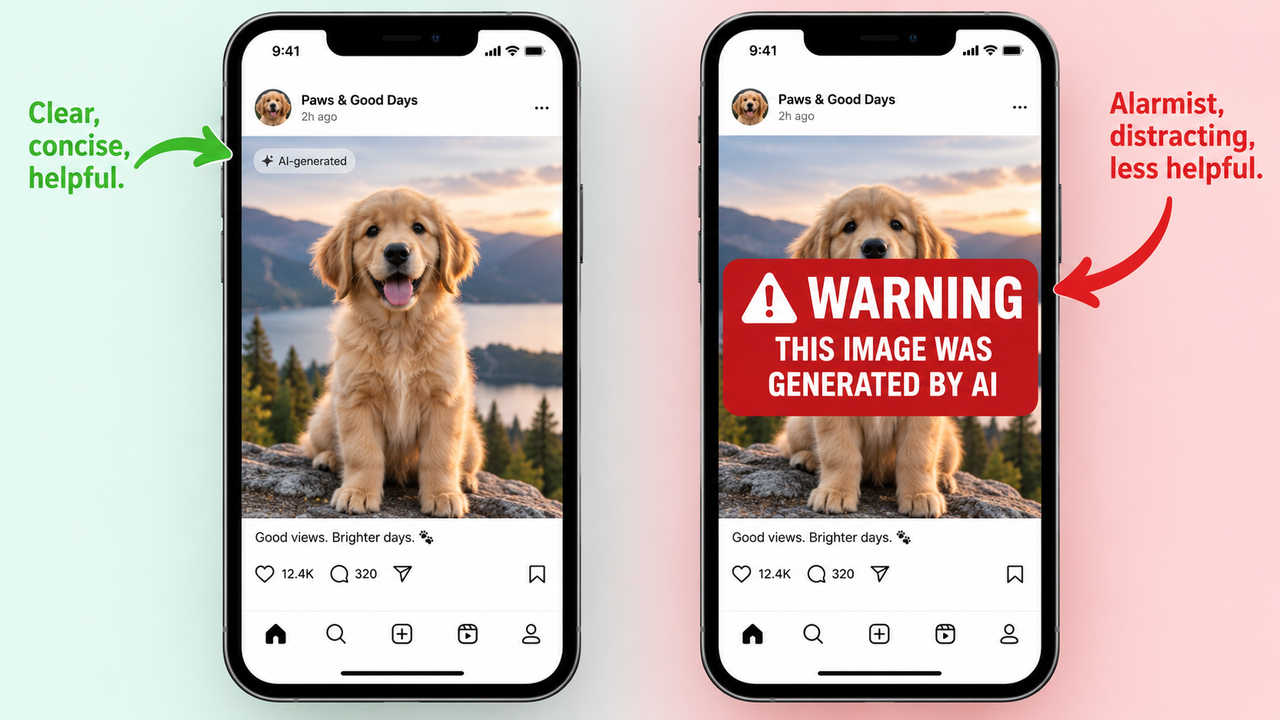
TikTok's AI disclosure is not optional for realistic AI imagery, audio, or video, and the two label paths are not equivalent. Self-disclosure renders as a small tag with no meaningful distribution hit; auto-detection applies a label that reads as deceptive and can trigger additional moderation review. AI-generated endorsements are banned outright, which kills the "AI spokesperson reads a product script" format for anything commercial.
Most creators land between $0.03 and $0.10 RPM on Shorts after YouTube's cut, with finance, tech, and US-heavy audiences skewing high and broad entertainment skewing low. An AI Shorts channel doing 1–5 million monthly views realistically pulls $20–$300 from ad revenue alone. Long-form runs $1–$30 RPM — 10x to 100x per view — so Shorts is the growth engine and the long-form or off-platform offer is the actual business. Q4 ad spend lifts RPMs now through December.
Lightricks shipped the full open-source LTX-2 — 14B video plus 5B audio params, with weights, training code, datasets, and inference tooling on GitHub and Hugging Face. It does native 4K at 50fps with lip sync, foley, and ambient audio in 10-second generations, and Artificial Analysis ranked it top-3 for image-to-video behind Kling 3.5 and Veo 3.1. The operator angle is fine-tuning: a model you can train on your own look is a moat that API-only competitors cannot copy.
Noah Morris runs roughly 20 faceless channels at 2.5 million-plus combined subscribers, and one court-case video cost $250 to produce and returned over $20,000 on 5 million views. Fern's 3D crime documentary channel is estimated north of $80,000 a month on ad revenue alone, and business documentary channels at 600K monthly views clear $3,300–$8,400 from AdSense. Faceless formats in the AI and tech niche grew 18x year over year — crowded, but the long-form documentary lane still prices well.
The October 2, 2026 ComfyUI release added work-in-progress Wan 2.2 Sound-to-Video support with optimized memory usage, plus real performance gains for generations past 120 frames and better memory estimation to stop OOM crashes mid-render. If you're batching long clips overnight, this is the update that stops wasting GPU hours. Workflow templates need build 0.3.46 or later.
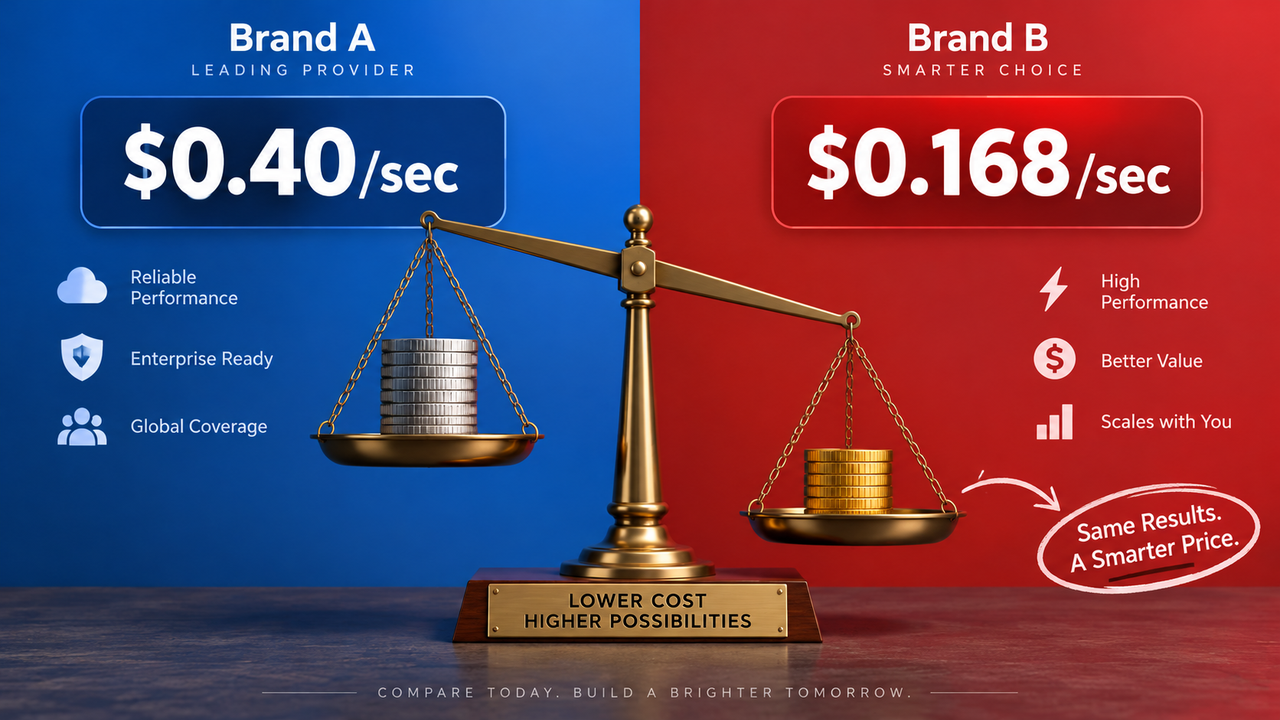
Veo 3.1 runs $0.40 per second at 720p–1080p and $0.60 at 4K with audio included, and watermark-free output requires the $249.99/month Ultra tier. Kling 3.0 Pro with audio lands near $0.168 per second from $6.99/month. Veo wins face consistency and native dialogue audio; Kling wins motion quality and camera movement at a fraction of the cost. Kling crossed $300M annualized revenue in January and 60 million creators by February — that's where the volume operators went.
OpenAI is building granular character controls and a revenue share for IP owners who opt in, with rights holders able to charge for cameo appearances of their characters. There is still no official revenue share for creators posting their own Sora videos. OpenAI has also called Sora's unit economics "unsustainable" and launched paid generation credits, because per-user generation volume blew past projections while most videos reach tiny audiences. Treat Sora as a distribution and reach play, not a revenue line.
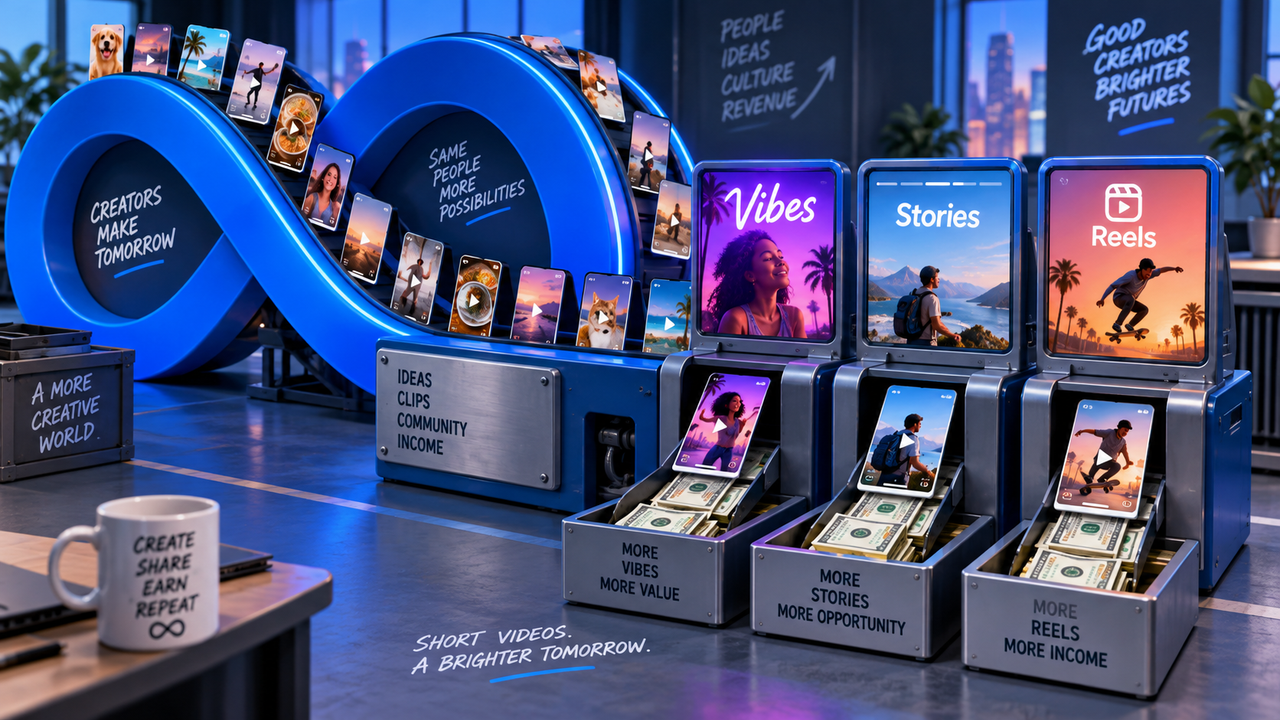
Meta's Vibes feed is an all-AI short-form surface on the Meta AI app and meta.ai, and Meta has been directly paying creators to keep a consistent supply of content flowing into it. Daily active users on the Meta AI app jumped from under 800,000 to roughly 2.7 million around the Vibes launch, though it still trails Sora. Vibes cross-posts straight into Instagram Stories and Reels, so the same render can feed three surfaces.