OpenAI's Sora 2 API goes dark September 24, 2026 — the consumer app was already killed in April. Any workflow or automation pipeline still calling Sora 2 has exactly 62 days to migrate. Kling 3.0 and Veo 3.1 Fast are the logical landing spots, with Hailuo as the value alternative for physics-heavy content.
Kling 3.0 is scoring 91 out of 100 in current June 2026 benchmarks — highest of any generator tested — and its free tier allows up to 66 clips per day. That is enough throughput to run full prompt audits and build a style library before committing production budget. At roughly $0.10 per second blended on paid, it is also the cost leader for multi-shot sequences.
TikTok's new 4-tier AI disclosure system, enforced as of July 16, uses automated C2PA detection to flag unlabeled AI content even without creator self-disclosure. Enforcement removals for unlabeled AI content are up 340% versus 2024. Label everything — realistic AI video, AI-altered audio, AI-generated imagery — or the algo pulls it before it can travel.
MiniMax's Hailuo remains the price-performance leader for physics-realistic AI video at roughly $0.30 per 10-second 1080p clip. Fastest turnaround in class, best physics simulation at this price point. If you are running satisfying-object or kinetic content, this is your workhorse — and the satisfying-physics niche is currently one of the cleaner algorithmic safe harbors across both TikTok and Shorts.
"Which would you choose" AI gallery polls are clearing 20 million views with strong comment and share rates — the decision prompt is the engine. Physics-based satisfying clips (liquid pours, domino sequences, kinetic destruction) are hitting consistently on both platforms. Horror and true crime faceless narration with AI B-roll is a third lane with strong CPM and lower competition than the top slots in general AI content.
YouTube's mid-July enforcement wave deleted 35 million subscribers — a second action following the 4.7 billion view purge from earlier in 2026. New signals target content quality directly, not just spam patterns. A Kapwing study of 15,000 trending channels found 278 all-AI channels running an estimated $117 million in annual ad revenue. That pool is actively shrinking as detection matures.
Creator breakdowns confirm operators now average 3.4 tools per production pipeline, up from 1.2 a year ago. The trigger for most who made the switch was a reliability failure mid-campaign, not a quality optimization. Current winning stack: Recraft V4 or GPT-Image-2 for assets, Kling 3.0 for sequences, Veo 3.1 for cinematic, Seedance 2.0 for reference-driven continuity, Wan 2.2 local for VRAM-efficient output.
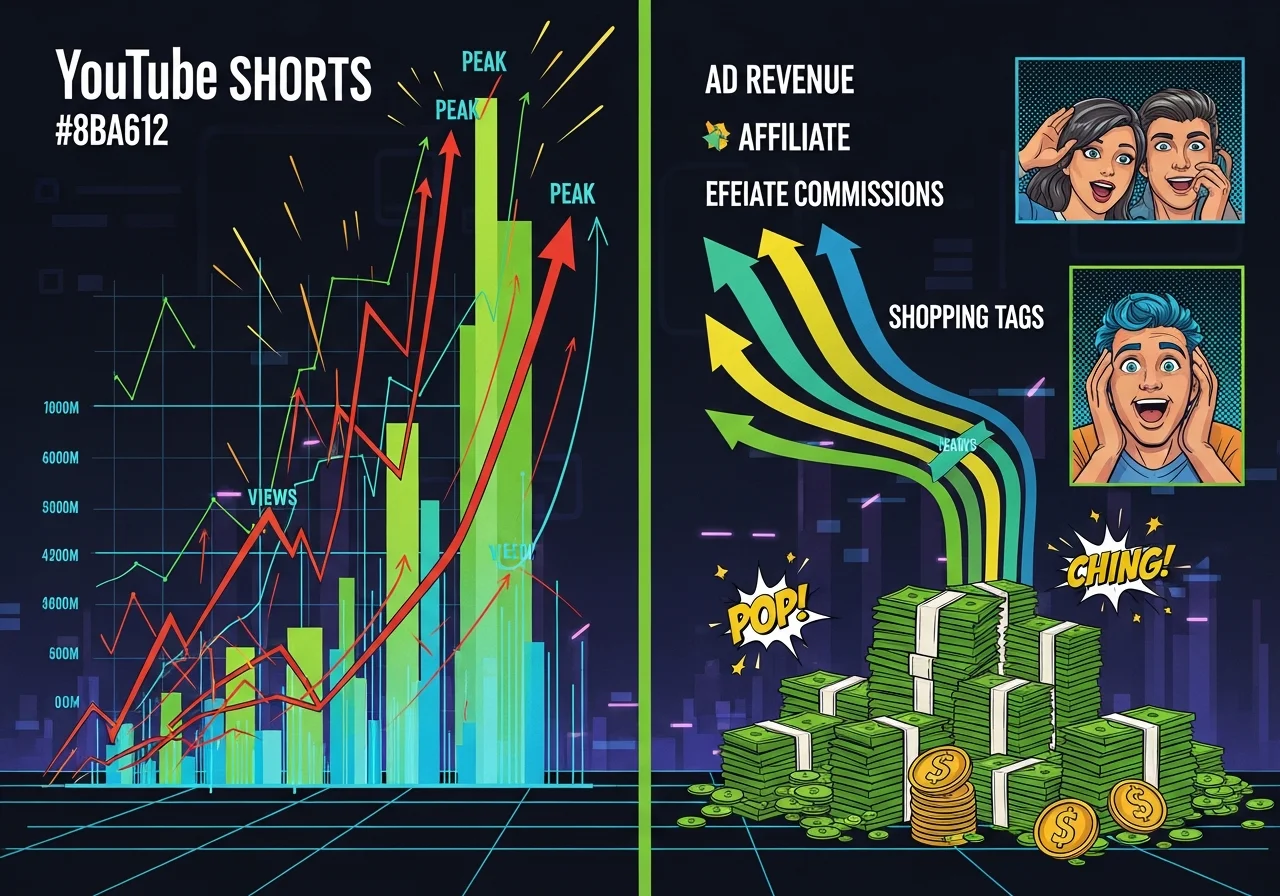
YouTube Shorts RPM runs $0.01 to $0.12 per thousand views in 2026, with US audiences at the top of that range. Hitting $5,000 per month from ad revenue alone requires 40 to 100 million monthly views. Mid-tier channels posting $10,000 per month in AdSense are typically running $25,000 to $40,000 total — ad revenue is only 30 to 50 percent of the picture. Affiliate, sponsorships, and digital products carry the rest.
Higgsfield AI went from zero to $200 million ARR in nine months, now sitting at $500 million ARR with 24 million users and reportedly pursuing a $500 million raise at a $5 billion valuation. The platform powers 390 Fortune 500 companies. Its focus is physics-realistic social video at scale — which puts it squarely in the same production workflows AI operators are building.
Creator monetization platform Fanvue is at $200 million annualized run rate, doubled in five months. Seventy-two percent of creators on the platform use AI tools, and those creators report 3 to 6 times higher earnings than non-AI users. The earnings differential confirms what operators already know: AI tooling compounds revenue, not just output volume.