US creators qualifying for the Creator Rewards Program are pulling $0.80 to $1.20 per 1,000 qualified views — a 30- to 40-times jump over the old Creator Fund's $0.02–$0.04 rate. Eligibility requires videos over one minute and 100K valid views in 30 days; AI content is fully eligible with the platform's built-in disclosure label applied.
ByteDance previewed Seedance 2.5 at its Volcano Engine FORCE conference June 23 and is targeting a public launch in early July — possibly this weekend. The upgrade brings native 30-second single-pass generation (up from 12 seconds), up to 50 reference inputs, 10-bit color depth, and native audio sync in a single model pass. Community workflow recommendation already circulating: use Seedance for long reference-heavy drafts, use Veo 3.1 for hero shots and lip-sync dialogue.
Google's Veo 3.1 is live inside the YouTube Create app at zero cost to all Shorts creators — no API fees, no third-party subscription. The new Ingredients to Video feature converts a single photo into a vertical Short; Video-to-Video transformation lets creators reformat existing library clips. No other major platform offers free, built-in AI video generation at this level, making YouTube the lowest-cost-to-produce Shorts environment right now.
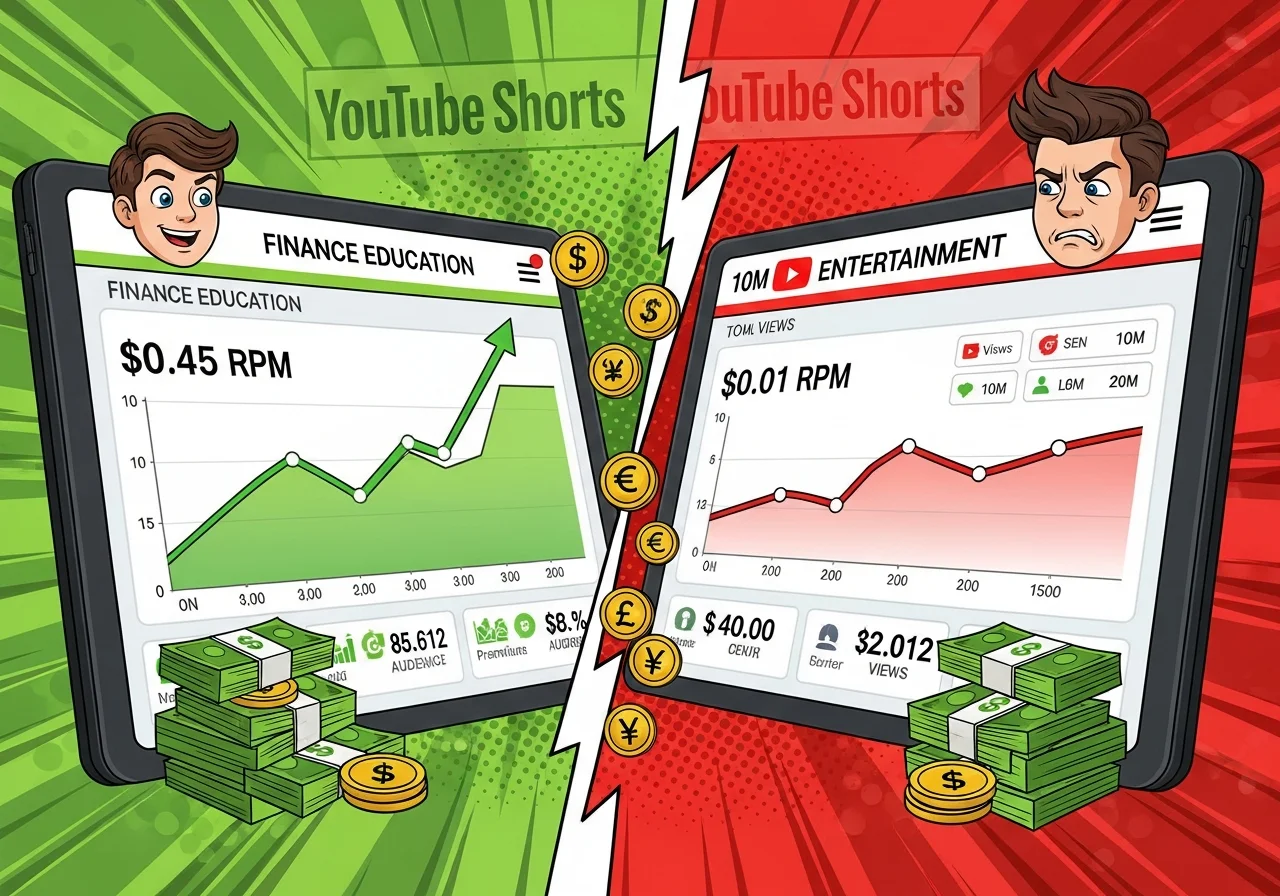
Analysis of 500 viral Shorts shows finance content earning $0.15–$0.45 RPM versus entertainment's $0.01–$0.05 — a 9 to 45 times multiplier from niche selection alone. On long-form, AI and tech tutorial channels are landing $14–$38 RPM, the highest ceiling in this cycle's data. A finance creator at 500K views out-earns an entertainment creator at 4.5M to 22M views.
All three major platforms now have active AI disclosure enforcement. TikTok runs the most aggressive system: a four-tier penalty framework from warning to permanent ban for unlabeled realistic AI content, with 1.3 billion videos already processed via C2PA Content Credentials detection. Critically, disclosed AI content carries zero penalty to For You feed eligibility or monetization on all three platforms — label it and there is no downside.
Kling AI's Motion Control feature — feed it one photo plus a reference motion clip and the subject animates to match — drove the app to the number-one download position in multiple markets and has been generating virals continuously since. At CES in January, Kling reported 60 million users and a $240M annualized run rate; the company has since raised $2 billion as Kuaishou spins off the AI video unit toward a planned IPO. The dancing-avatar format is worth cloning now before saturation.
ComfyUI reached a $500 million valuation in April 2026, institutional confirmation that local-control pipelines are a real market. Alongside this, MimicPC launched a Creators Earnings Program paying operators for sharing ComfyUI workflows on their platform — turning production pipelines into a secondary revenue stream separate from video ad revenue.
Wan 2.2 14B holds the community consensus for self-hosted video generation: Apache 2.0 commercial license, best-in-class open-source motion realism, and the 5B variant running on 8GB VRAM. The official ComfyUI workflow is at Workflow > Browse Templates > Video > Wan2.2 5B. Wan 2.6 and 2.7 guides are circulating but require cloud or API access — for local operators, 2.2 is still the answer.