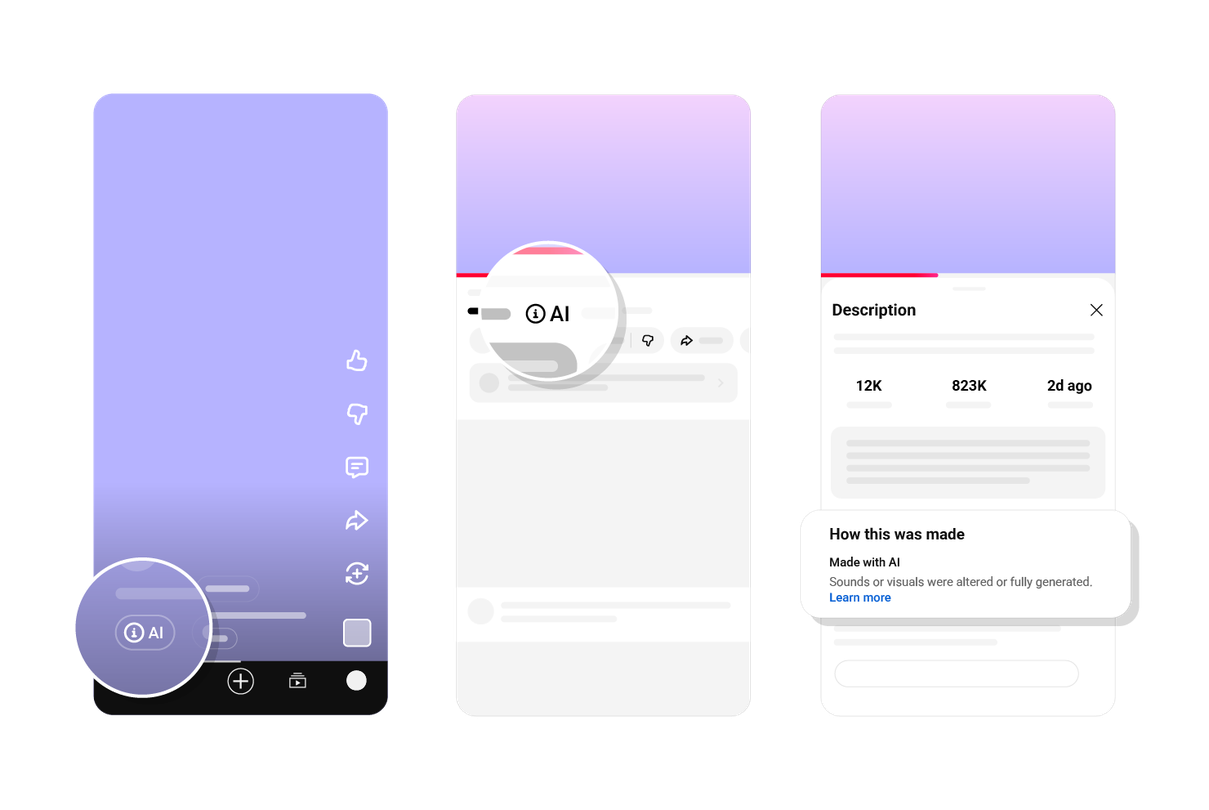
As of May 27-28, YouTube is now automatically detecting and labeling videos that make "significant use of photorealistic AI," even if the creator doesn't disclose it. Labels move from the buried description to directly below the video player on long-form and as overlays on Shorts. Content made with YouTube's own tools (Veo, Dream Screen) or carrying C2PA metadata gets a permanent, non-removable label. Creators can dispute false positives in Studio, but the era of stealth AI uploads is effectively over. Critically, YouTube says the label alone doesn't change recommendations or monetization eligibility — but undisclosed AI content they catch can face reduced distribution or removal.
January 2026 marked the biggest mass termination of AI-driven channels in YouTube history, and it's still rolling. Channels earning $30K/month have been stripped overnight. Over 4.7 billion lifetime views and 35 million subscribers were erased. The trigger: a July 2025 policy rename broadened "repetitive uploads" to "content lacking genuine human creativity." Template clones, AI slideshows with synthetic narration, and identical-format daily uploads are getting flagged fastest. Survival playbook: freeze uploads during review, inject personal perspective into scripts, replace static visuals with motion, add human voice commentary, and vary formats between uploads.
Google just shipped Veo 3.1 Lite (announced May 28) as a low-cost developer API at less than 50% the cost of Veo 3.1 Fast, plus the consumer version gives every personal Google account 10 free Veo 3.1 video generations per month — no credit card, not a trial, ongoing. Supports text-to-video and image-to-video, portrait (9:16) and landscape (16:9), up to 1080p, with direct YouTube publish. For operators running multi-platform distribution, that's 10 free high-quality clips monthly as a baseline before touching your own pipeline.
Alibaba's Wan 2.7 shipped in late March and is now broadly available. The headline features for operators: specify both start and end frames and the model interpolates the motion between them, combine a face reference with a voice reference for character consistency across clips, and edit existing videos with natural language prompts. Still open-source, still runs local on 24GB VRAM for the 14B model. For anyone running ComfyUI pipelines with Wan 2.2, this is a direct upgrade path with significantly more creative control.
TikTok now explicitly blocks fully AI-generated videos from earning through the Creator Rewards Program. The line they draw: AI as a production tool (captions, color grading, audio cleanup) is fine; AI as the producer (generating the entire video) is not. They've pulled 51,618 synthetic media videos and permanently banned 8,600 accounts for AI violations, with a four-strike escalation from content removal to permanent monetization ban. Virtual influencers are excluded entirely from CRP. The play for AI operators on TikTok is now affiliate and brand deals, not platform ad revenue — or ensuring enough human creative input to stay on the right side of the line.
TikTok's May 2026 algorithm update pushes the viral completion-rate threshold from 50% to 70%. Meanwhile, 60-180 second videos are now outperforming 15-second clips as TikTok chases YouTube's ad inventory model. Original audio gets priority over trending sounds. And 64% of Gen Z is using TikTok as a search engine, making keyword-loaded captions and on-screen text a distribution lever. For AI video operators: this means tighter hooks, story-arc pacing over quick cuts, and SEO-style captioning on every post.
MiniMax's Hailuo 2.3 introduces the "Media Agent" — a one-click workflow that auto-selects the right multimodal models for your content without manual editing. The Fast model cuts batch creation costs by 50% compared to Hailuo 02, while outputting 1080p at 6 seconds or 768p at 10 seconds. New style support covers anime, illustration, ink wash, and game CG alongside near-photorealistic renders. For operators running volume plays, the cost-per-clip math just got a lot friendlier.
Three AI video breakouts worth studying: @FashionFuturist's infinite-zoom video transitioning through fashion eras hit 134 million views. "AI Cinema" used Seedance 2.0 to create a reality show starring animated fruits and pulled 39 million views. @FutureCast2050's documentary-style future scenarios (2030-2050) reached 64 million views. The pattern: conceptual novelty plus strong visual hooks plus formats that reward rewatching. None of these are template clones — they're high-concept, single-creator visions executed with current-gen tools.