Google announced May 21 that CapCut's editing suite will embed directly into the Gemini app, joining Adobe Firefly and Canva integrations unveiled at Google I/O. Creators will be able to prompt Gemini to trim clips, format aspect ratios, and apply effects without switching apps. No firm launch date yet — "soon" — but this collapses the ideation-to-publish gap for anyone already using Gemini for scripting or image gen. Worth watching closely for Shorts workflow automation.
Alibaba's Wan 2.7 shipped via WaveSpeed and Together AI ($0.10/sec) with three features that matter for operators: First-Last Frame generation (define start and end, model fills the motion), up to 5 simultaneous reference videos for character/style consistency, and instruction-based video-to-video editing via natural language. This is the biggest open-model pipeline upgrade since Wan 2.2 — FLF2V alone solves the "random motion" problem that kills coherent Shorts.
YouTube's largest-ever mass termination wiped 16 channels (35M subs, ~$9.8M annual revenue). Biggest casualty: CuentosFacianantes at 5.95M subs and $2.6M/year. Flagged patterns: template-clone videos with only titles changed, AI slideshows with synthetic narration, fully automated daily upload pipelines with zero human creative input. YouTube explicitly still welcomes AI-assisted content — the line is human editorial judgment. Audit your channels for any template repetition.
SeedVR2's one-step 4X upscaler now runs on 8GB GPUs (RTX 3060/4060) via GGUF Q4 quantization — 85-90% of FP16 quality at a fraction of the VRAM cost and 12x faster than multi-step diffusion upscalers. MIT license, fully offline, ComfyUI drag-and-drop. The recommended stack is Seedance or Wan for generation, then SeedVR2 for the 4K pass. This makes broadcast-quality output accessible on consumer hardware.
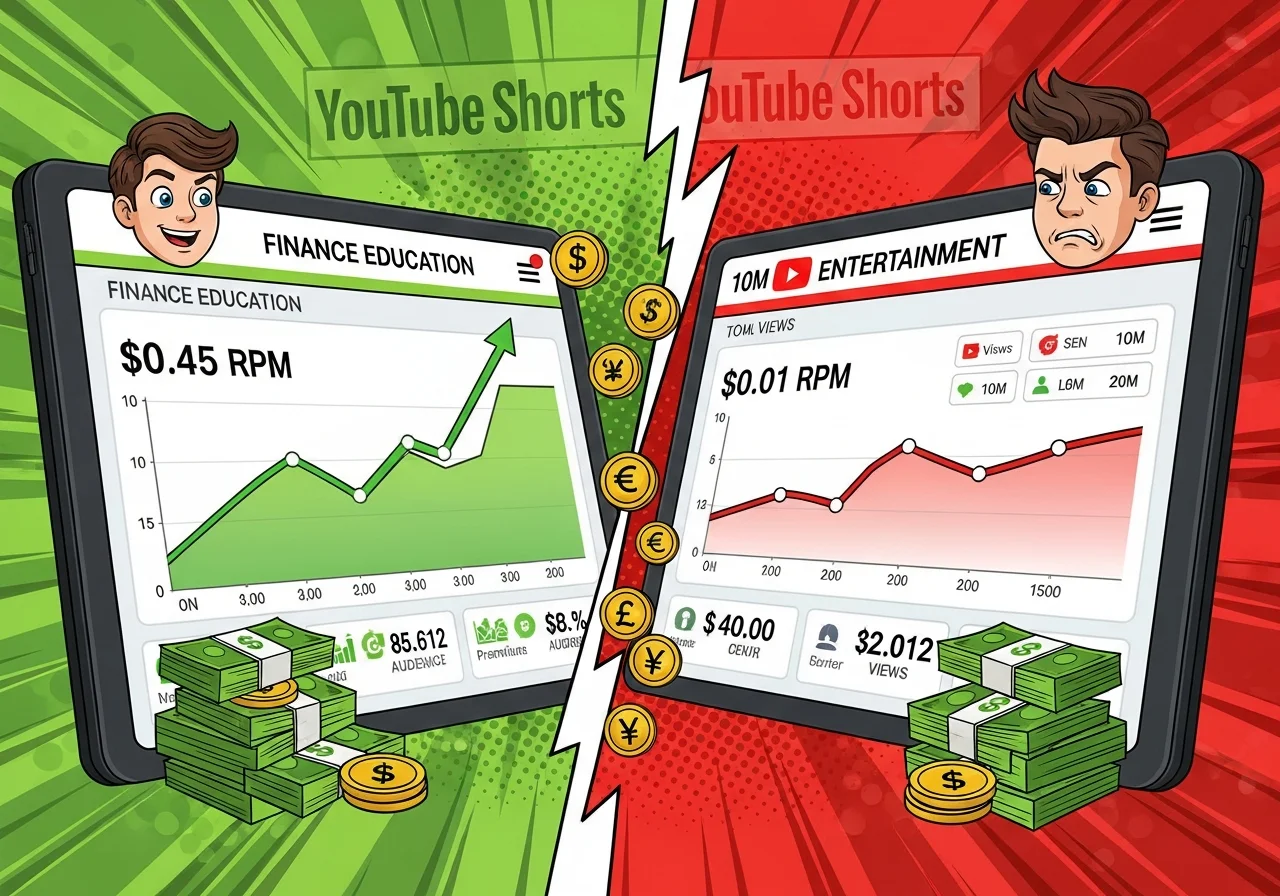
Fresh RPM data confirms the spread is massive: Finance/investing AI Shorts pull $0.15–$0.45 RPM vs. entertainment/comedy at $0.01–$0.05. Emerging micro-niches with near-zero competition: government contracting ($0.15–$0.25 RPM), senior care navigation ($0.12–$0.25, 19x growth), blue-collar career tips ($0.10–$0.18). Creator Bennett Santora's faceless channels hit $0.15–$0.30 RPM with tens of millions of monthly views. The play is niche selection, not volume.
Updated May 13, VideoFlow v3.0 is a single ComfyUI canvas covering T2V, I2V (first + last frame), and A2V with voice cloning from 5-second reference audio. LTX 2.3's two-stage sampling — half-res for motion, then 2x latent-space upscale — delivers sharp output without destroying temporal consistency. Combined with LoRA stacking for character/style conditioning, this is the most complete single-workflow solution on Civitai right now.
The 2026 Reels algorithm weights DM shares above everything — above watch completion, saves, comments, and likes. A Reel with 50 DM shares and moderate likes outperforms one with 500 likes and zero shares. 55% of Reels views come from non-followers. AI content with original voiceover and custom captions scores high on Instagram's originality check; fully synthetic without editorial input gets deprioritized. Five to seven Reels per week is the sweet spot for algorithmic momentum.
Seedance 2.0 and Kling 3.0 both exploded in early 2026 and continue to dominate r/aivideo. Kling 3.0 ships native 4K at 60fps with motion-control that spawned millions of dance-transfer videos. Seedance 2.0 generates cinematic video with synchronized dialogue and SFX from text prompts. Both are closed-source and API-only, but the quality bar they're setting is what your audience now expects from AI video — even from open-source pipelines.
A detailed cost analysis pegs actual per-video costs far above sticker price due to failed generations and QC. Budget tier: Pika $0.14, Hailuo $0.25, Kling standard $0.60. Mid-range: Runway Gen-4 $0.70–$1.00, Veo 3 Fast $0.90. Premium: Sora 2 ~$2.00, Kling with audio $8–$13.50. Multiply by 3–5x for real production. Open-source local gen (Wan, LTX) at electricity cost remains the margin play for volume operators.