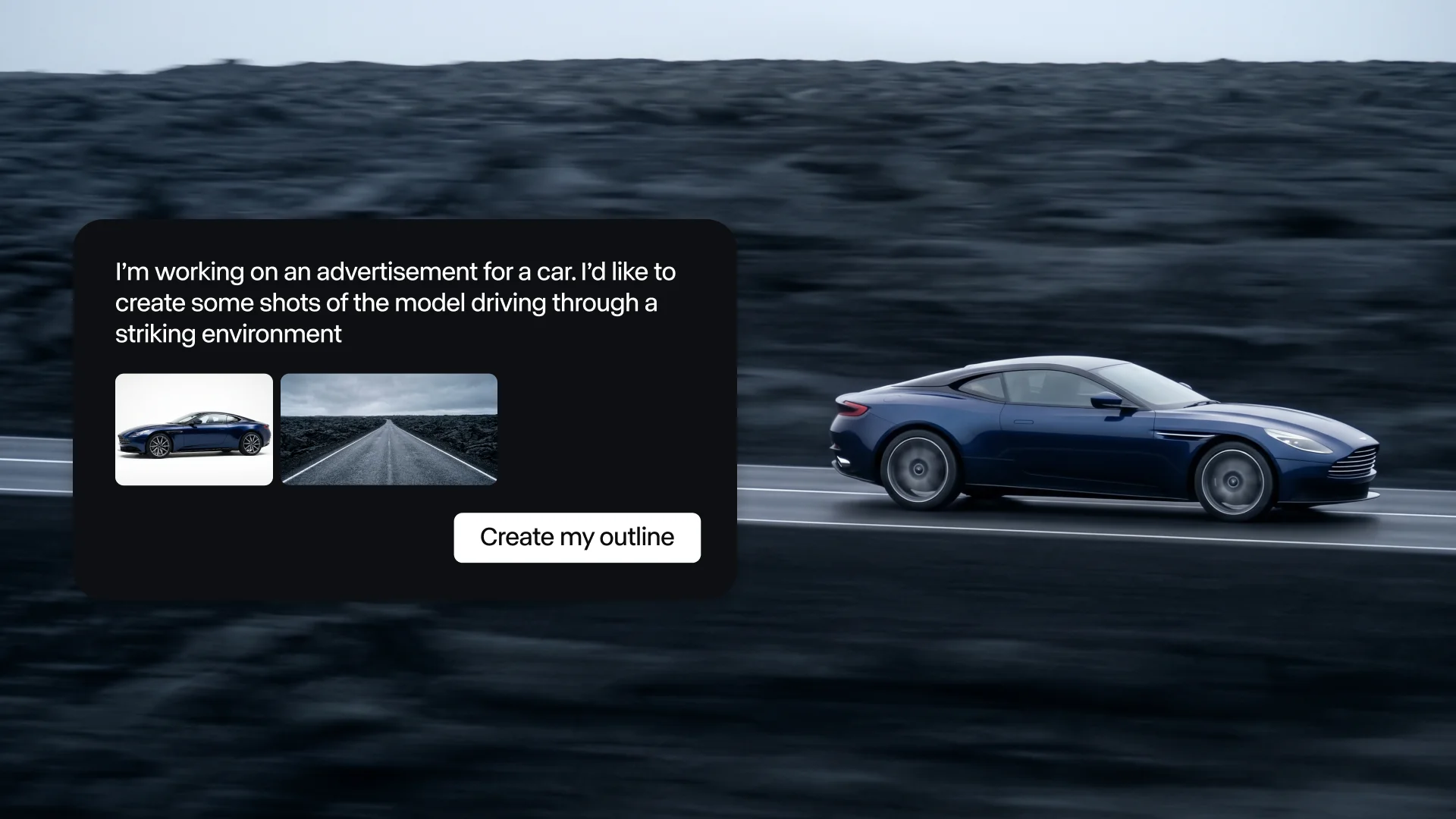
Announced yesterday at Google I/O 2026, Gemini Omni Flash generates 10-second video clips with synchronized audio from a single multimodal prompt (text, images, clips, or speech) and supports conversational editing. It combines Gemini with Veo, Nano Banana, and Genie under the hood. Available now for AI Plus subscribers; rolling out free on YouTube Shorts and YouTube Create later this week, with every output SynthID-watermarked. Audio editing inside generated clips is deliberately held back for now.
Launched May 13, Runway Agent is an agentic creative partner that takes a text brief, proposes concept and story beats, then generates a full multi-shot video with voiceover, dialogue, and music — all assembled and ready to publish. Built on Gen-4/4.5, it targets brand teams and creators who need high-volume social content. A timeline editor is available for final tweaks. Available now to all Runway subscribers.
Released May 13, this update adds partner nodes for ByteDance Seedream 4.0 (image gen with DynamicCombo), Flux2ImageNode, GrokImageEditNodeV2, a lightweight Veo 3 Lite video node, an OpenAI Image node, and a Claude LLM node for text generation inside workflows. Also includes Anima TE LoRA support in Kohya format, HiDream-O1-Image support, and 4K video output for ByteDance 2 nodes. Fp8 safetensors saving bug is fixed.
TikTok's 2026 algorithm prioritizes watch time and authentic human creators, actively deprioritizing AI-generated video. Fully AI-generated content is excluded from the Creator Rewards Program on originality grounds. Data shows fully AI channels achieve 10K+ followers only 8% of the time (vs. 62% for human-led content), with just 2% reaching sustainable income. TikTok's official line: properly labeled AI content isn't penalized, but the numbers tell a different story.
Alibaba's Wan 2.7 (released March/April 2026) adds first-frame and last-frame specification — the model generates everything in between — drastically cutting the trial-and-error loop. Also new: video-to-video transformation (restyle existing clips while preserving motion), subject referencing from a single image, 9-grid image input, up to 15-second clips, and improved audio sync. Free and open-source. Runs locally on an RTX 4090.
OpenAI discontinued the Sora app on April 26; the API shuts down September 24. The Wall Street Journal reported Sora was losing $1M/day. Disney has ended its three-year licensing agreement and dropped plans for a $1B investment in OpenAI. The practical shortlist for creators is now Veo 3.1, Runway Gen-4.5, Kling 3.0, and Seedance 2.0 — with Wan 2.7 leading the open-source tier.
Adobe's multi-year deal with Runway makes Adobe the "preferred API creativity partner." Gen-4.5 is available now inside Firefly with native audio generation, better motion, and shot-to-shot character consistency. Deeper Premiere Pro and After Effects integration is expected later in 2026, which would put Runway's generation directly into the NLE timeline.
A creator case study shows a Short with 1.5M views earned ~$10 in ad revenue but ~$1,200 in affiliate sales through YouTube Shopping Affiliate tools — a 120x difference. Shorts RPM sits at $0.01-$0.15, meaning ad-only monetization requires 40-100M monthly views to hit $5K/month (only 3% of monetized channels). Finance/B2B niches earn 10-30x more per view than entertainment. The takeaway: AI video creators should treat Shorts as a top-of-funnel affiliate play, not an ad revenue business.
As of May 5, Google DeepMind, Microsoft, and xAI joined OpenAI and Anthropic in signing CRADAs with NIST's CAISI for pre-deployment model evaluation. Over 40 assessments have been completed. Labs submit models with reduced safeguards for thorough capability testing. This means every major frontier model — including those powering video generation — now goes through federal review before public launch, which could affect release timelines.